




From lab to law: why materials science, consumer insight, and policy have to move together
By Ahmed Saleh, Executive Director, IECC (Innovation, Entrepreneurship and Competitiveness Center), Nile University, and Irene Samy, Director, SESC (Smart Engineering Systems Research Center) and Professor of Industrial Engineering, Nile University
Over this series, we have walked through the alternatives to single-use plastics in Egypt one at a time: what biodegradable materials really cost, what the life-cycle numbers say about recycling, what consumers will actually pay for, and where a foresight exercise with industry expects the country to land by 2050. If there is a single thread running through all of it, it is this: almost nothing in this field succeeds or fails on its own terms.
That is the finding worth ending on, because it changes how a company, a ministry, or an investor should approach the problem.
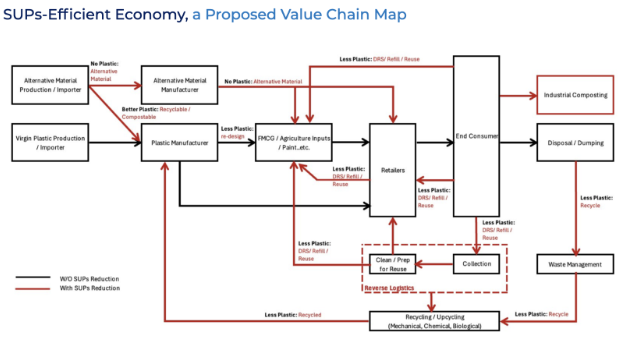
Everything depends on something outside itself
Look back at what each piece actually showed.
A biodegradable plastic like PLA is a materials achievement. But it only delivers an environmental benefit if there is industrial composting to receive it at end of life, only sells if consumers will pay the premium, and only scales if policy or cost makes the premium worth bearing. Take any one of those away and the material becomes an expensive way to make the same waste.
A refill or deposit-return model is a business-model innovation. But it cannot scale without reverse logistics to retrieve and clean containers, and our consumer survey showed people welcome it without yet demanding it, which means it needs a nudge to convert. The technology is rarely the bottleneck. The system around it is.
Recycled PET and HDPE are a materials-and-process question, but the experts ranked recycling below waste management for impact, precisely because better recycling capacity is starved without better collection feeding it.
The one near-self-contained win, lightweighting through redesign, pouches, and concentration, is exactly the alternative that the study flags as deliverable in the short term, because it depends least on everyone else moving first. That is not a coincidence. The fewer external dependencies an intervention has, the sooner it works.
The report's answer is a system, not a silver bullet
This is why the study's recommendations for Egypt do not pick a winner. They span the whole chain at once: improve waste management infrastructure, grow the supply and quality of recycled plastics, strategically adopt biodegradable materials for the hard-to-recycle cases, encourage lightweighting, build out reverse logistics and deposit-return systems, and phase in restrictions on the thinnest plastic bags.
Two things about that list matter as much as its contents.
First, it deliberately mixes materials, products, business models, and policy because the report's own evidence shows that these levers only work in combination. Second, every recommendation is phased across short, medium, and long horizons and designed to avoid shocks. That caution is not timidity. It is the lesson from places where a sudden ban cost tens of thousands of jobs, which we opened the series with. Moving all the levers together and moving them gradually is how you avoid trading one problem for another.
Even "policy" is a portfolio
It is tempting to think the materials and market work is the hard part, and policy is just the switch you flip at the end. The study draws on a well-established framework that classifies interventions into five distinct types: command-and-control regulation, economic instruments such as taxes and subsidies, service and infrastructure, collaborative public-private agreements, and communication and education.
A plastic bag rule is command-and-control. A deposit-return scheme is an economic instrument. Reverse logistics is infrastructure. A producer-responsibility deal is a collaborative agreement. The three-tier recycling label is communication. Getting from a lab result to a law that works means knowing which of these tools fits which problem, and sequencing them so they reinforce rather than undercut each other.
From lab to law
Trace a single alternative through its full life and you can see why no one discipline owns it. A material is proven in a lab. Its real environmental value is established through life-cycle assessment. Its commercial fate is decided by what consumers will accept and pay. Its scale depends on the business model and the logistics around it. And its reach is set by the policy mix that either pulls it into the market or leaves it stranded. From lab to law, the same intervention passes through materials science, consumer behavior, business design, and regulation, and a weakness at any stage stops it.
That is precisely why this study was done by two centers rather than one, and why we have signed each of these articles together.
The Smart Engineering Systems Research Center (SESC) covers the first half of that journey: which alternative materials genuinely perform, and whether a substitution is a real environmental gain or a costlier path to the same footprint. The Innovation, Entrepreneurship and Competitiveness Center (IECC) covers the second: how technologies are forecast, how products and business models are redesigned, and whether the market and the consumer will actually carry them. Together, the two centers can take a question from the material all the way to the model and the mandate, which is the only level at which problems like this one are actually solved.
For a company weighing a switch, a ministry shaping a regulation, or an investor sizing a circular-economy bet, that is the practical offer: not a single answer, but a partner that can see the whole chain at once, and tell you where the weak link is before you build on it.
Egypt's single-use plastic challenge will not be solved in a lab, or a boardroom, or a parliament alone. It will be solved where those three meet. That intersection is where we work.
Acknowledgments
This series draws on a study made possible by many hands. We thank our co-authors Sherifa ElHady, ElHassan ElSabry, Amira Yassin, Sherif Hamed, Rana Adel, and Amir Azmy, and we are grateful to Asmaa Ahmed, Amr Hashim, Dina Tolba, Marwan Rashwan, and Salma Salah for their critical contributions. We also thank Asmaa Ahmed and Merna Hammad of Nile University, whose coordination and industry engagement were instrumental to the work.
We are grateful to Matthias Pfaff and Nahomi Nishio at UNIDO Headquarters, and to Eman Shaaban, Ahmed Ibrahim, and Abdulrahman Hag Elamin at the UNIDO Egypt office, for their guidance and for facilitating access to key data. Finally, we thank the Ministry of Environment and the industry leaders, policymakers, NGOs, and private-sector representatives who gave their time to the interviews and the validation workshop, and the Government of Japan, whose funding made the study possible.
About the authors
Ahmed Saleh is the Executive Director of the Innovation, Entrepreneurship and Competitiveness Center (IECC) at Nile University, where he works at the intersection of technology management, innovation, and entrepreneurship to strengthen industry competitiveness in Egypt and the region. An engineer by training, he has led innovation and venture-building programs, including work with Nile University's NilePreneurs initiative. He is currently a PhD candidate at Nile University's Graduate School of Management of Technology (MOT), where his research interests include technology commercialization in developing economies and digital transformation strategies.
Irene Samy Fahim is a Professor in the Industrial and Service Engineering and Management department at Nile University and Director of the Smart Engineering Systems Research Center (SESC). A Fulbright alumna, she holds a PhD in Mechanical Engineering from the American University in Cairo. Her research centers on sustainable materials, including bioplastics, natural-fiber-reinforced composites, and non-plastic single-use tableware made from sugarcane bagasse. She is a Senior Member of the IEEE and a recipient of the L'Oreal-UNESCO For Women in Science award (Egypt, 2021), the State Encouragement Award for Women (2020), and the Hazem Ezzat Research Excellence Award (2021).
Read the full study: Mapping Study of Alternatives to Single-Use Plastics: Reducing Single-Use Plastics in Egypt (UNIDO, 2025), commissioned under the project "Supporting the Promotion of Circular Economy Practices in the Single-Use Plastic Value Chain," with funding from the Government of Japan.
About the centers: The Innovation, Entrepreneurship and Competitiveness Center (IECC) and the Smart Engineering Systems Research Center (SESC) at Nile University.