

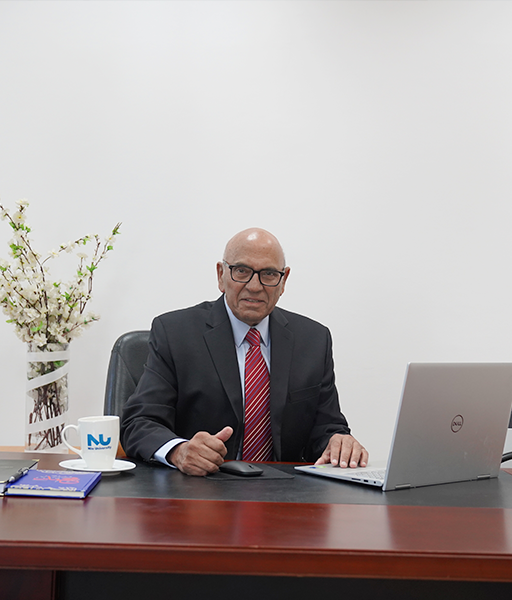

Prof. Mohamed Ezzat
Acting Dean of the Graduate School of Management of Technology & Professor of Management of Technology
Faculty Building
UB2
Dr. Mohamed O. Ezzat is a distinguished quality and manufacturing engineering executive whose career spans more than five decades across the global automotive, hospitality, and higher education sectors. Born in Egypt and received his formal higher education in the Egyptian and American universities, he has built a reputation as both a rigorous practitioner of quality systems and a dedicated mentor to the next generation of industrial engineers. He currently resides in Las Vegas, Nevada, where he continues to lead his own consulting practice while serving as a professor and academic administrator in Egypt.
Dr. Ezzat's academic journey began at Cairo University in Egypt, where he earned a Bachelor of Science in Aeronautical Engineering in 1963. He went on to pursue graduate studies in the United States at Texas Tech University in Lubbock, Texas, completing a Master of Science in Industrial Engineering in 1971 and a Doctor of Philosophy in Industrial Engineering in 1975. This combination of aeronautical and advanced industrial engineering training would shape a career defined by precision, systems thinking, and continuous improvement.
Dr. Ezzat's professional path began in the classroom. From 1974 to 1977, he served as an Assistant Professor in the Manufacturing Engineering Technology Department at Weber State University in Ogden, Utah, teaching foundational courses in manufacturing and industrial engineering. After spending a period in the industry, he returned to Weber State University as a tenured Full Professor from 1988 to 1989, teaching advanced subjects such as design of experiments, operations research, supply chain management, statistical process control, and quality management, while supervising senior capstone projects.
In 1977, he joined John Deere Corporation, the global leader of agriculture equipment manufacturers at the Component Works in Waterloo, Iowa, where he spent eleven years advancing through progressively senior engineering management roles. As Manager of Manufacturing R&D, he established and led a CAD/CAM department of twenty-two engineers and programmers and directed the installation of a major hydraulic products facility built on cellular manufacturing principles. He later served as Manager of Manufacturing Engineering Services, overseeing a team of thirty engineers in facilities planning and material flow analysis, and ultimately as Quality Engineering Manager, where he directed a supplier certification program and the development of a $1.6 million metrology center, delivering measurable cost savings and efficiency gains along the way.
Dr. Ezzat's expertise in supplier quality took on national scale in 1989, when he became the Director of Supplier Quality Assurance at Navistar International Transportation Corporation, a leading manufacturer of medium and heavy-duty trucks in Westchester, Illinois. Over a decade in this role, he rationalized Navistar's supplier base by half, reducing the supplier's count from 1,400 to 760, and led Kaizen and Six Sigma Black Belt initiatives that together generated millions of dollars in annual savings. He also chaired the Truck Advisory Group within the Automotive Industry Action Group (AIAG), helping to shape the QS-9000, and then TC16949, quality system requirements adopted across the automotive and truck industries globally.
In 1999, he became the Director of Quality for Brake, Chassis, Ignition, and Fuel Products at Federal-Mogul Corporation in Southfield, Michigan, overseeing the implementation of QS9000 across forty-five global plants. Three years later, he joined Ford Motor Company, first as a Supplier Technical Assistant (STA) manager for powertrain machined parts, and then, from 2003 to 2008, he moved to China as STA Manager of Ford's China Sourcing Office in Shanghai and Nanjing. In that role, he led a team of twenty-five Chinese graduate engineers responsible for developing Chinese suppliers capable of exporting more than four billion dollars in quality components to Ford’s plants in North America, Europe, and Australia, while driving the supply chain's defect rate below thirty parts per million.
Dr. Ezzat brought his automotive-honed quality discipline to a new industry in 2008, when he joined Las Vegas Sands Corporation in Las Vegas, Nevada as Executive Director of Supply Chain. There he designed and implemented global Supplier Quality Requirements covering both Furniture, Fixtures and Equipment (FF&E), and Food and Beverage (F&B) suppliers, managing a multinational staff across the United States and China until his retirement in 2012.
Rather than stepping away from the field, he founded Lotus Engineering Consultants in Las Vegas in 2013, where he continues to serve as President. Through the firm, he partners with clients in the automotive and hospitality industries to assess quality systems, improve product designs, and resolve chronic supplier problems using the Global 8D problem solving methodology.
In 2016, Dr. Ezzat joined Nile University in Giza, Egypt, as Professor in the Management of Technology (MOT) school, teaching various subjects such as project management, knowledge management, statistical process control, and total quality management, while supervising the research work for the post-graduate candidates for the Master and doctoral degrees. In 2025, he was appointed Acting Dean of the MOT school, where he has since led efforts to strengthen the school's ties to industry and government, established an alumni-driven advisory board, and guided a strategic review of the school's vision, mission, and curriculum.
Dr. Ezzat is a Certified Engineer in the states of Texas and Utah, a Certified Global 8D instructor, a Certified Quality Engineer (CQE), and a Certified Quality Auditor (CQA). He has been recognized with the Outstanding Achievement Award from the Automotive Industry Action Group and has held adjunct professorships for business schools at the University of Wisconsin, the University of Northern Iowa, and the University of Nevada, Las Vegas.
He has dual citizenship of Egypt and the United States.