



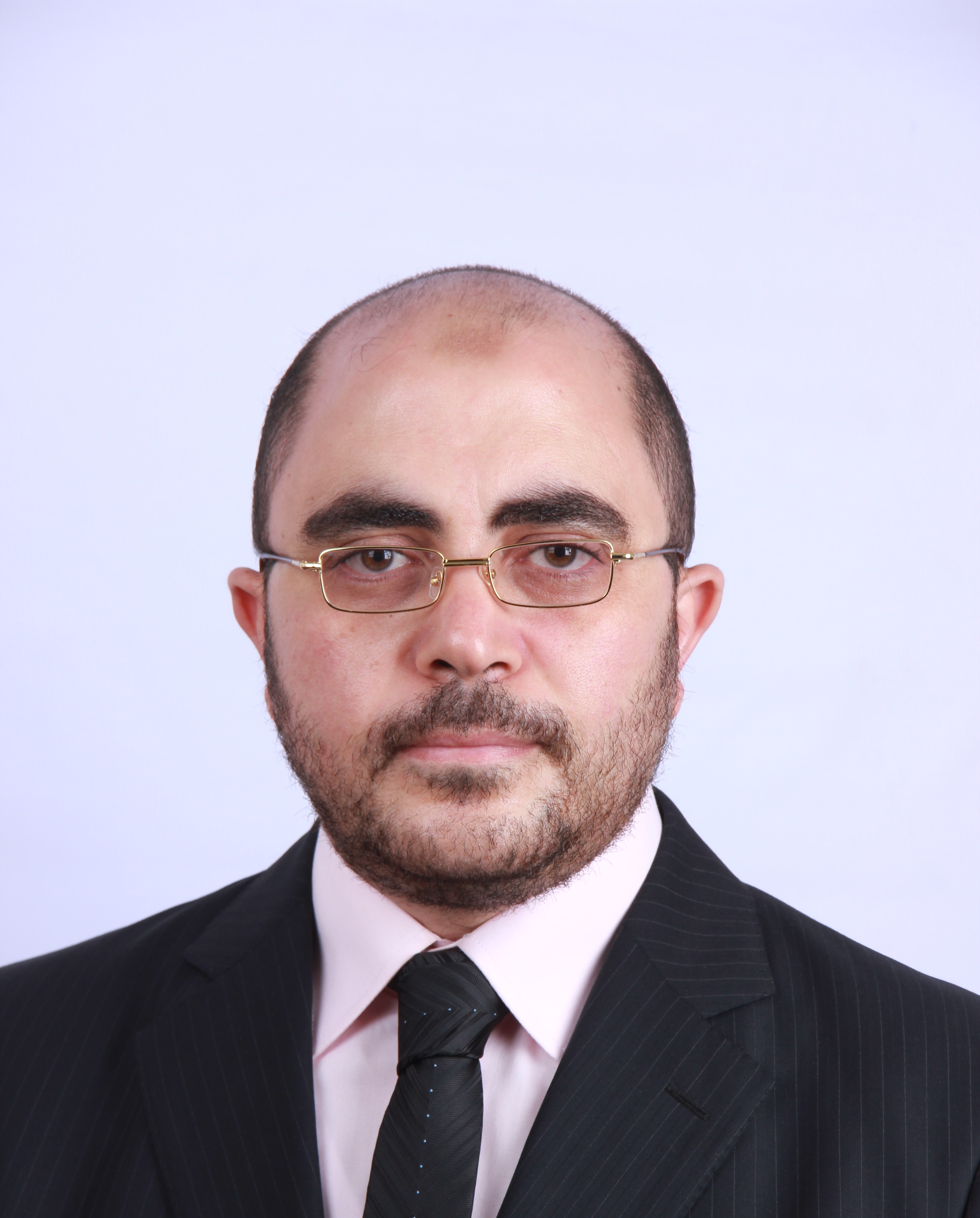


Dr. Ahmed F. Elnokrashy
Associate Professor
Dr. Ahmed F. Elnokrashy is an Associate Professor and Program Director of the Computer Science Department at the School of Computer Science, Nile University, Egypt. He holds B.S., M.S., and Ph.D. degrees in Systems and Biomedical Engineering from Cairo University, Egypt. His academic and professional career combines extensive R&D experience in medical systems with research and innovation in artificial intelligence, computer vision, medical imaging, and data analysis.
From 1998 to 2013, Dr. Elnokrashy worked in research and development, specializing in the design and implementation of medical systems, with a primary focus on ultrasound, hemodialysis, and intensive care monitoring systems. His early work focused on hardware development, including analog and digital systems, printed circuit boards (PCB), and field-programmable gate arrays (FPGA). He subsequently expanded his expertise into software development for medical applications, including medical signal processing for ultrasound Doppler, pulsed-wave Doppler, and color Doppler systems, as well as medical image reconstruction and real-time 3D visualization. During this period, he contributed to the development of software and integrated systems for several medical devices, particularly ultrasound and hemodialysis systems.
From 2013 to 2017, Dr. Elnokrashy served as an R&D Manager at IBETECH, a Bahgat Group company specializing in the development and manufacturing of advanced medical systems. In this role, he was involved in the design, development, and manufacturing of medical equipment and contributed to the advancement of the company's technological capabilities.
Dr. Elnokrashy's academic research has focused on signal processing, medical imaging, computer vision, and data analysis. He joined the Faculty of Engineering at Benha University as an Assistant Professor in the Department of Electrical Engineering, Biomedical Engineering section. During his academic career, he participated in several research and technology-development projects, including four ETIDA-funded projects related to medical imaging and intelligent medical systems. He also successfully completed an ETIDA-funded project in collaboration with Dileny, an AI and technology company. The project contributed to the company's technological development and was followed by its acquisition by a US-based corporation.
In the field of artificial intelligence and computer vision, Dr. Elnokrashy has collaborated with and provided consultancy to companies seeking to integrate AI-based computer vision technologies into their workflows and operational processes. His work has particularly included applications in the medical and vascular domains, including the use of computer vision and AI technologies to support vascular planning procedures and enhance clinical decision-making.
Since 2023, Dr. Elnokrashy has been a member of the School of Computer Science at Nile University, where he currently serves as an Associate Professor and Program Director of the Computer Science Department. In this role, he contributes to academic leadership, curriculum development, program coordination, and the advancement of computer science education. His current research interests lie at the intersection of artificial intelligence, computer vision, medical imaging, and intelligent data analysis, with a particular emphasis on developing practical AI solutions that bridge academic research and real-world applications.
More recently, Dr. Elnokrashy's research interests have expanded into the application of artificial intelligence in financial markets. His work explores the use of AI for both technical and fundamental financial analysis, with the goal of developing intelligent systems that can analyze complex market information, identify patterns and trends, and support investors in making more informed financial decisions.
Through his combined experience in academic leadership, research, industrial R&D, medical technology, and AI-driven applications, Dr. Elnokrashy focuses on translating advanced computational and AI techniques into practical systems that address real-world challenges.
-
Artificial Intelligence
-
Computer Vision
-
Medical Imaging
-
Ultrasound
-
Signal Processing
-
Visualization
-
Parallel Computing
-
Healthcare AI
-
Data Science
-
Financial AI